

Meet-the-first-female-leather-professor
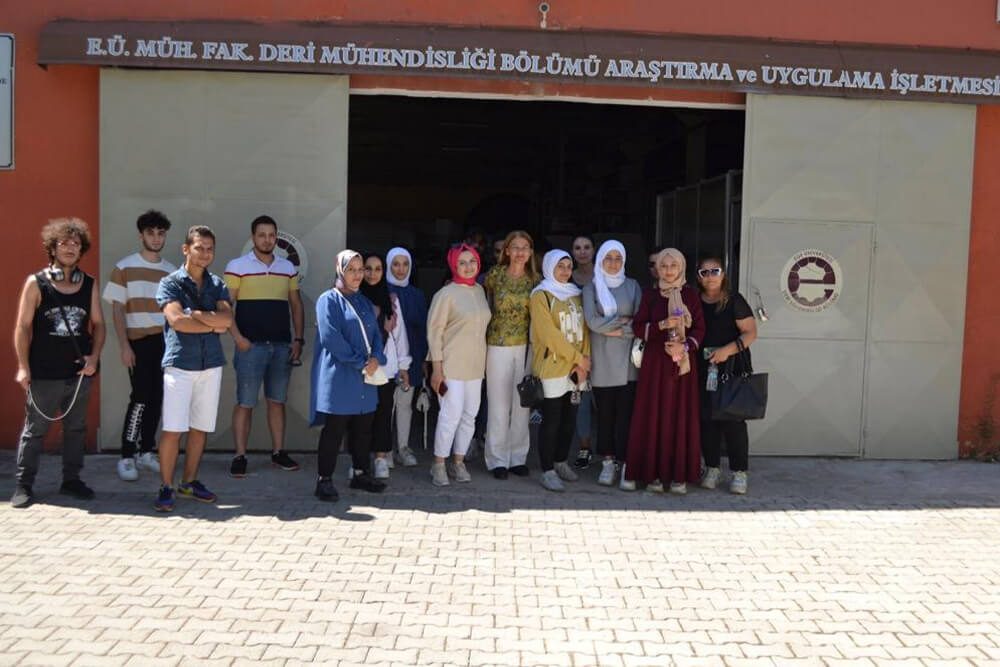
Meet the first female leather professor Prof. Dr. Eser Eke Bayramoglu.
You are the first female leather professor. Could you please explain us where your love for leather comes from.
My father came with me on the day I went to my first leather training at Ege University in 1989. Actually, choosing the leather department was a bit of a coincidence for me. My father was a big reader and told me motivational stories about leather that day. He said that I had chosen the best profession and that I would be very successful in this field. He motivated me and was with me as long as he lived. I am grateful to my mom and dad for supporting me.
Can you please explain us more about your work.
I work full time at Ege University. I have lots of lessons Leather Microbiology, Marketing, Leather Handycrafts etc.. I provide various training programs in line with the demands. I give Leather Technology trainings especially for different groups. I had a graduate student set up a cosmetic company and I am a consultant there. Flamel Kimya is the first and only hydrolyzed keratin producer company in Türkiye. We also make natural products that have no equivalent for the skin.
Some while ago you gave a training on the leather industry in Kazakhstan. Why in Kazakhstan and what was the goal of this project?
I have a doctoral student at M. Auezov University in Kazakhstan that I am the second advisor. We have a bilateral cooperation agreement with this university. They invited me to give Leather Technology training. Due to this invitation, I went to Kazakhstan and gave certified training to school teachers, doctorate students and graduate students.
Are there any other recent projects you can inform us about?
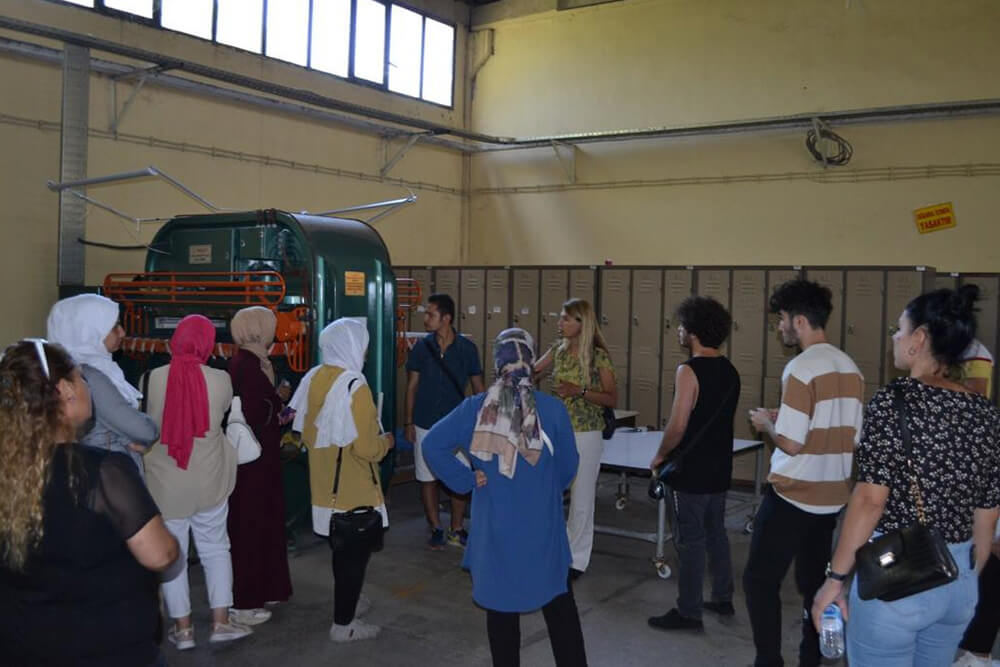
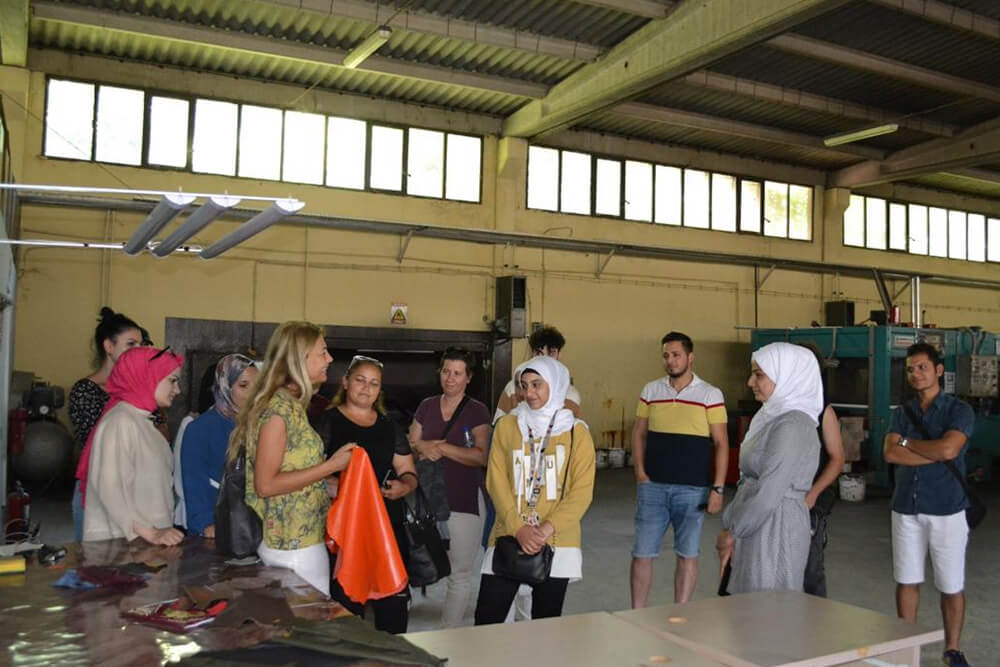
For the time being with the partnership of the United Nations World Food Programme, the Izmir Chamber of Commerce, the Ministry of National Education and İŞKUR, we provide training to train leather cutting and sewing operators at the Ege University continuing education centre. Within the scope of this program, mostly Syrian refugees are provided with employment. The photos you see were taken during this course.
In this context, I give leather technology trainings. In addition, I received an invitation to a training program from Uzbekistan and we are still in talks on this subject.
How do you feel about the sustainability of leather?
I think that for the sustainability of the leather business, it is necessary to make an environmentally friendly production, as well as that this business should be loved and adopted by young people. Leather work is actually a difficult job, but it can be done with love.
Why is leather such a unique material?
Leather is actually a waste material. A waste material turns into a unique product in the hands of an artist. According to Ahi Evran, who is considered as the master of this business in Türkiye, leather making is not only a craft, but also an art, even the highest of the arts, because it requires patience.
How do you think the tannery of the future looks like?
I think tanneries will be a piece of heaven because they will turn to natural chemicals. Maybe everything that will be farmed with the waste from the factory will be green… This is my dream. The next day will come.
What should consumers need to know about leather?
Leather makers use a material that is a food industry waste and transform it into very valuable products. Leather is obtained from animals, materials obtained from plants or fungi are not leather. We, leather tanners, do not harm animals, we protect nature. Leather is one of the oldest professions known, and good leather processing played a huge role in the establishment of civilizations.
Do you think should leather be the material of choice for consumers? If yes, please explain why.
Definitely. I don’t think any material can replace leather. Unrivaled products are made from leather and history is full of them. A parchment book is invaluable today. Leather creates a visually rich atmosphere. This is why especially artists prefer leather. Leather is both stylish and cool, comfortable and healthy. Wearing leather gives prestige. What more could a consumer ask for?

Modest Vintage Player
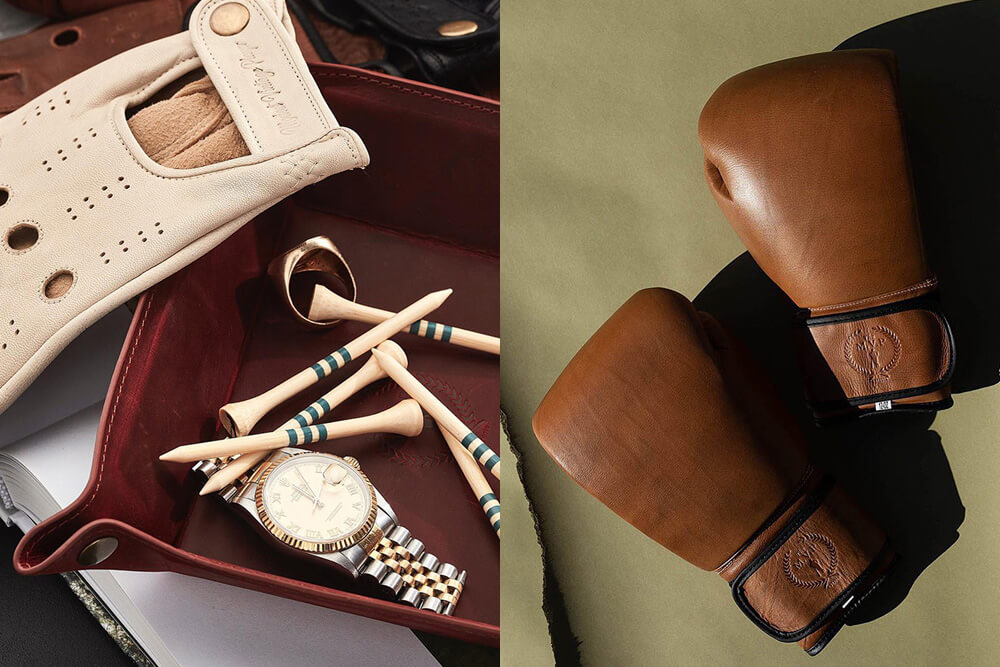
Modest vintage player is crafting beautiful and practical sports & recreation goods from fine leathers.
Modest vintage player is crafting beautiful and practical sports & recreation goods from fine leathers. The collection is handmade in small batches by artisans who have spent their lives learning the art of crafting. MVP is against mass production, but opts for exclusivity. Well, Auckland’s Modest Vintage Player mission is to bring class back to sport by preferring leather craftsmanship over mass production
Longevity has always been a must in the history of sport. Punching bags, headgear and gloves are just a few items designed to withstand whatever impact they may face.
Read about the drive of CEO and Creative Director Josh Carmody
“Naturally, leather was a huge part of the equipment used in these old school sports eras, which is the dominant material used with our products. Sourcing the best quality leather and finding the right factories to partner with was a costly process, but we have established some really strong partnerships in this space.”
How did the idea of creating such a brand come about?
I have always loved sports since I can remember, growing up with an older brother our days and nights were spent in the backyard duelling out a game of football, cricket, rugby, or playing catch ending only when dinner was called or one of us in tears over a disagreement!
I had a great hunger to create something unique, something aligned with my passion for sports, history & culture.
I came up with the MVP (Modest vintage leather) brand concept – a sporting goods brand to celebrate the players, equipment & culture of by-gone eras, from the ’60s to the ’90s. I am constantly inspired by the old school athletes who played purely for the love of the game.
I get a real excited re-living archived video footage of the big stars like Michael Jordan, Maradona, Tiger Woods, and Muhammad Ali in their prime – outfits & of course the equipment they were using.
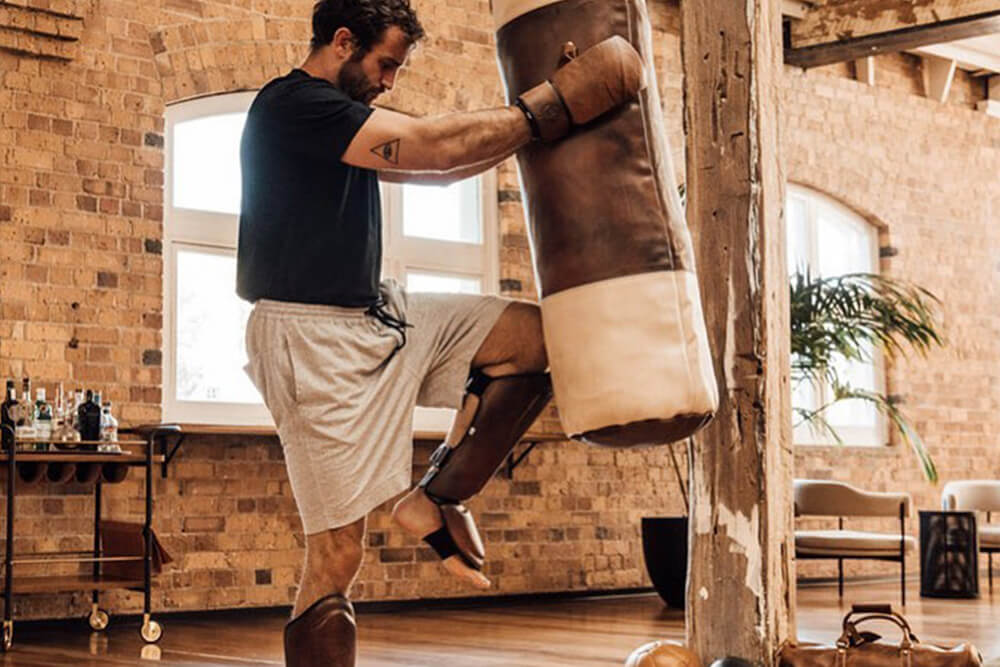
How do you do this creative research, bringing current references and aesthetics within the leather universe to so many different sports and places?
Our understated and casual gear reflect our attitude toward life & how athletes used to go about their business.
“We tend to favor neutral leather Pantones with clean colorways & simple natural logo deboss which is very much against the grain with today’s more flashy designs and company logos.”
When working on a special project, this is where we can be more creative and experimental, evident in our recent collaboration with artist Kehinde Wiley, in which we created a full-color leather basketball in the same design as one of his most celebrated paintings.
“There is no real limit on what we can achieve in the sporting goods space, which is why we get so excited when we get approached with cool projects.”
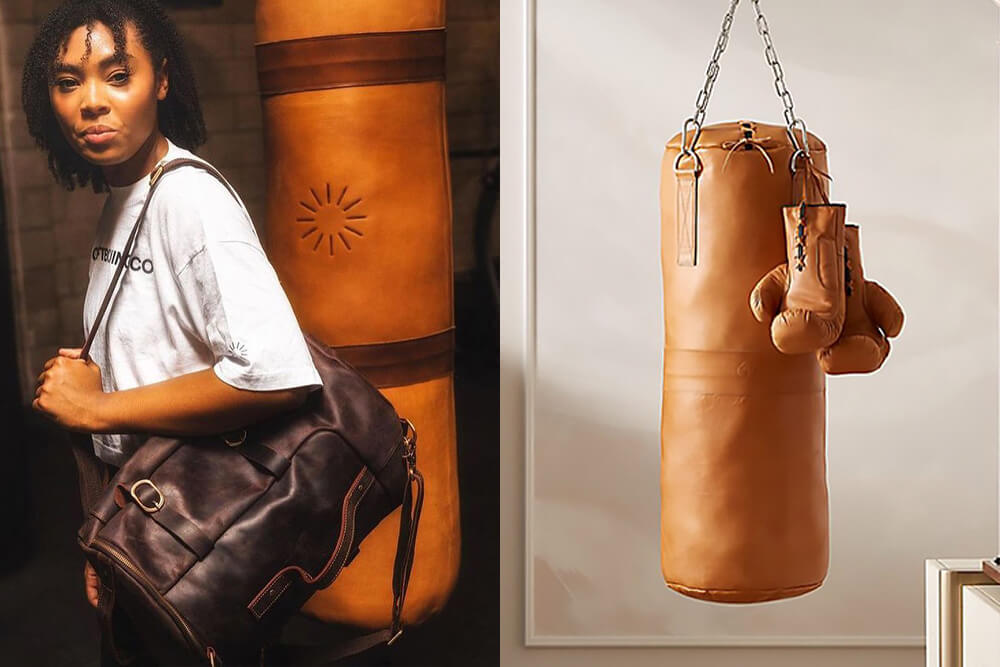
Is there a difference in how you design, treat, and think about leather for each sport, for example?
There is definitely a lot to consider when producing leather products for each sport – for each of our product niches, we will use specific cuts of leather, different gauges, regarding the thickness and also different types of material, from cowhide to buffalo.
“Each leather has certain properties which suit different products. Most of our products are made with full-grain cowhide leather as this type offers strength, durability, and workability for most products.”
But for example, our Golf Gloves are made with a high quality sheep leather which has a beautiful soft texture and provides enhanced grip for the golf club, and our balls are made from a special bison hide which provides a rugged and authentic look & feel. Our product development team is constantly experimenting with different types of material and tanning techniques to offer something unique.
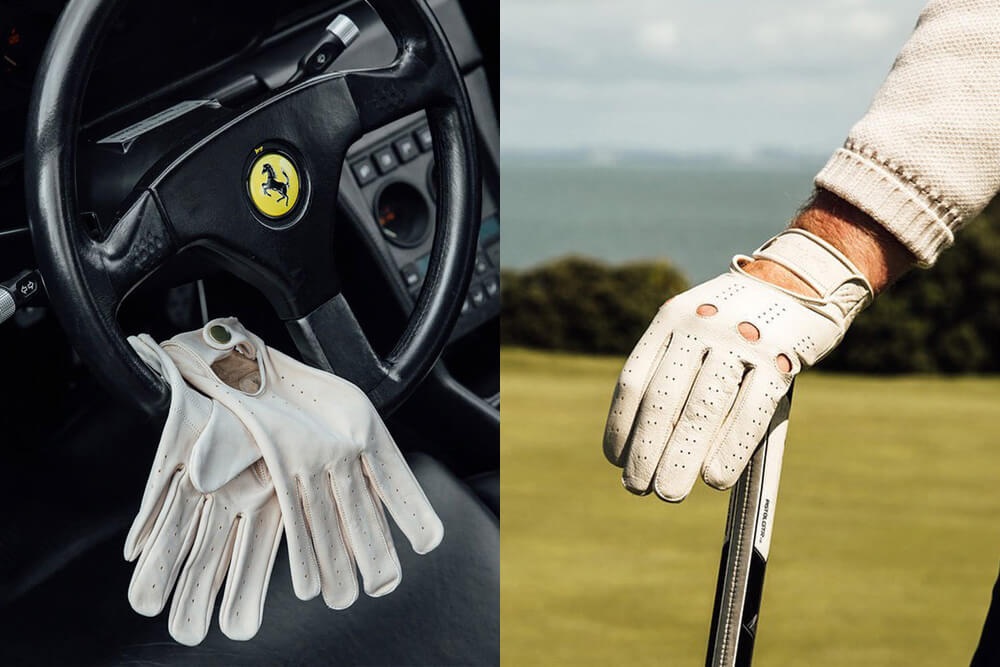
What are Modest Vintage Player plans for the future?
The future for MVP is exciting, we have just signed an official licensing agreement with arguably the world’s biggest sporting club which we hope will get us in front of a massive global audience. We are also looking to delve into clothing offerings. Simple, clean high-quality staples after the hugely successful launch of our first range which sold out in a matter of days.
Lastly, we would love to open up a flagship retail store where we can really engage with our MVP fans, and where our products can be touched, used – and smelled.
“Leather products really are better in person as each item is a little unique, something that e-commerce can’t really show clearly.”
Real Leather. Stay Different
Leather and Hide Council of America partners with the African Leather and Leather Products Institute to launch Real Leather. Stay Different. African Talent Leather Design Showcase 2023 (RLSD African Showcase ’23.
- Partnership commits to “Educating the Next Generation of Creatives and Re-Shaping our Fashion Futures”
- RLSD African Showcase ‘23 will promote sustainable leather and leather products production among small and medium sized enterprises
- Dedicated series of fashion, production and sustainability workshops to empower African designers of tomorrow.
The Leather and Hide Council of America [L&HCA] and the African Leather and Leather Products Institute [ALLPI] have partnered to launch the Real Leather. Stay Different. African Talent Leather Design Showcase 2023 [RLSD African Showcase ‘23]. The new partnership, which commits to ‘educating the next generation of creatives’, aims to reshape education around the production and use of sustainable leather across Africa.
Through the RLSD African Showcase ’23, L&HCA and ALLPI will promote the development of sustainable leather production among small and medium sized enterprises. As part of the initiative, a dedicated education program will be delivered, via a workshop series hosted at ALLPI’s satellite design studios located in its ten member countries, that explores fashion, production and sustainability.
The workshops will be designed to help improve business efficiency and minimize negative environmental and social impacts. They will be open to creatives studying or working at small and medium sized enterprises and will showcase the future of leather design, its sustainability benefits and how innovations can be implemented within their creative practices to further reduce waste.
Real Leather. Stay Different. has a strong ethos of supporting the next generation of creative business talent with an aim to re-build, re-educate, and re-position. The new partnership brings to the forefront a common set of values to support sustainable leather value chains and emerging creatives through education.
The RLSD African Showcase ’23, is open to talent studying or working in art and design via the ALLPI’s design studios. Showcase participants will be challenged to design a single piece of apparel, accessory, footwear or furniture item using natural materials and 50% or more leather. Shortlisted finalists will be invited to create their design concept at one of the ALLPI’s satellite design studios. Finalists will present their work during a live showcase finale at the All Africa Leather Fair 2023 in Addis Ababa, Ethiopia.
Mr. Gehbregziabher Ghebremedhin, Programs Coordinator at the African Leather and Leather Products Institute, said:
“The RLSD African Showcase ’23 extends our commitment to bring the highest ethics for business and the environment to leather production systems, supporting sustainable small and medium sized enterprises and businesses while improving business practices and the environment.
“Not only will it become a platform to showcase beautiful leather and leather products but it will also highlight that leather bags, clothes, footwear and furniture, if maintained properly, can last indefinitely. As part of the prize for making the global finale, finalists will have their design on display at the African Talent Leather Design Showcase 2023 as part of the All Africa Leather Fair 2023, an invaluable and significant opportunity.”
Steve Sothmann, President for Leather and Hide Council of America, commented:
“The showcase’s mission is to spark the interest of African designers to work with responsibly produced real leather which puts hides that would otherwise go to waste, to good use. Real leather doesn’t just look good, it is better for the environment than its man-made alternatives and they make products so durable that each can last a lifetime – its quintessentially ‘slow fashion’.
“Too many of our fashion choices end up in landfill, creating an unwanted legacy from today’s society that will damage the environment for centuries. Fast fashion means not only more consumption, but the increased use of fossil fuels and associated environmental impacts in the form of toxics and microfibers. Working with ALLPI gives us the opportunity to empower the next generation with skills that reduce waste in the design process.”
For more information on the Real Leather. Stay Different. African Talent Leather Design Showcase 2023, visit https://chooserealleather.com/competition/africa-competition-2022/

Gärsnäs
Gärsnäs is a brand that has been around for 127 years and still manages to bring innovation to the table.
The Swedish brand mixes high technology with meticulous craftsmanship and sustainable materials – like responsibly produced leather and hardwood from local forests. The result is long lasting iconic goods that never go out of style.
Even though it is a big problem for Gärsnäs to keep up with growing technology, nothing beats the human touch. It’s the skilled hands of the designers and collaborators that bring the brand’s character to life.
“Curious and sustainable” is the powerful statement of Gärsnäs. It is both the future and the past. How does it feel to create furniture, sustainable furniture, for so long?
We are proud to be a part of Gärsnäs history: that goes long back to 1893. We benefit and take advantage of knowledge and craft, experience and tradition while moving forward and creating new designs for the future.
Gärsnäs works with an extensive team of designers. You believe in genuine human craftsmanship. Could you describe this union process between creating with hands and also with extreme computer technology? What does it represent?
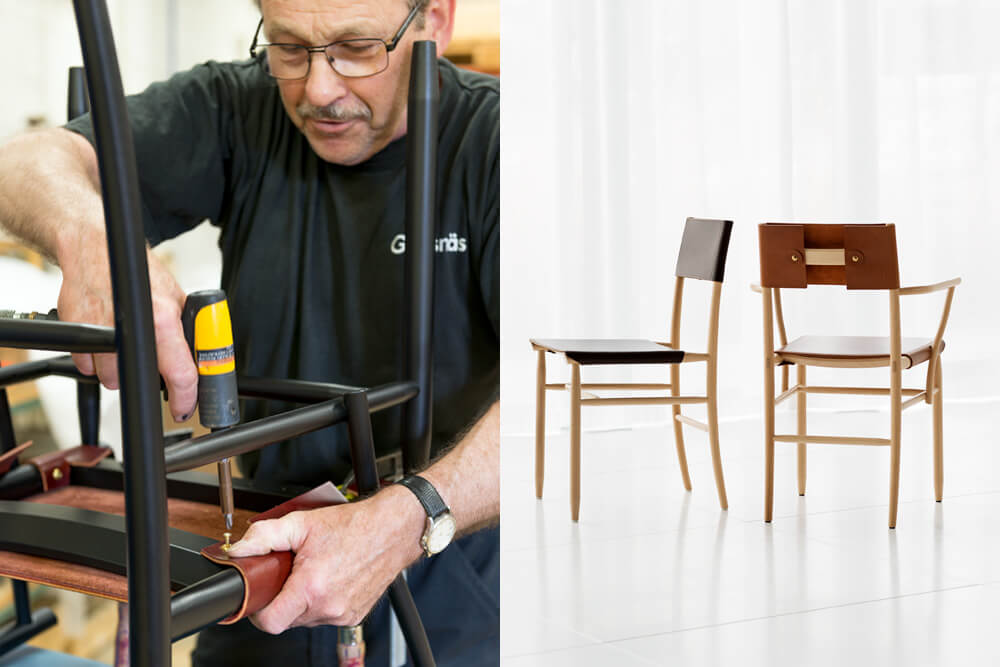
We are merging high technology with craftsmanship in the process of manufacturing furniture. The latest technology provides us with the efficiency and precision needed and also brings innovation to the developing process, where the technology allows us to produce in large-scale. The crafting embodies the handmade and the human touch, which are essential for the final result: it’s in our DNA and represents what the brand is all about. The object of design is worth nothing if it’s poorly made, it’s always better to make it simple, but well crafted.
How is this material seen, inserted, and thought within Gärsnäs?
Fact: Earth’s resources are burdened beyond the limit and we have found a quote on the Gärsnäs website that goes, “Our environmental requirements are very high regarding incoming material and processes. We seek the best methods and materials available from an environmental perspective.” So, still talking about materials: leather in furniture.
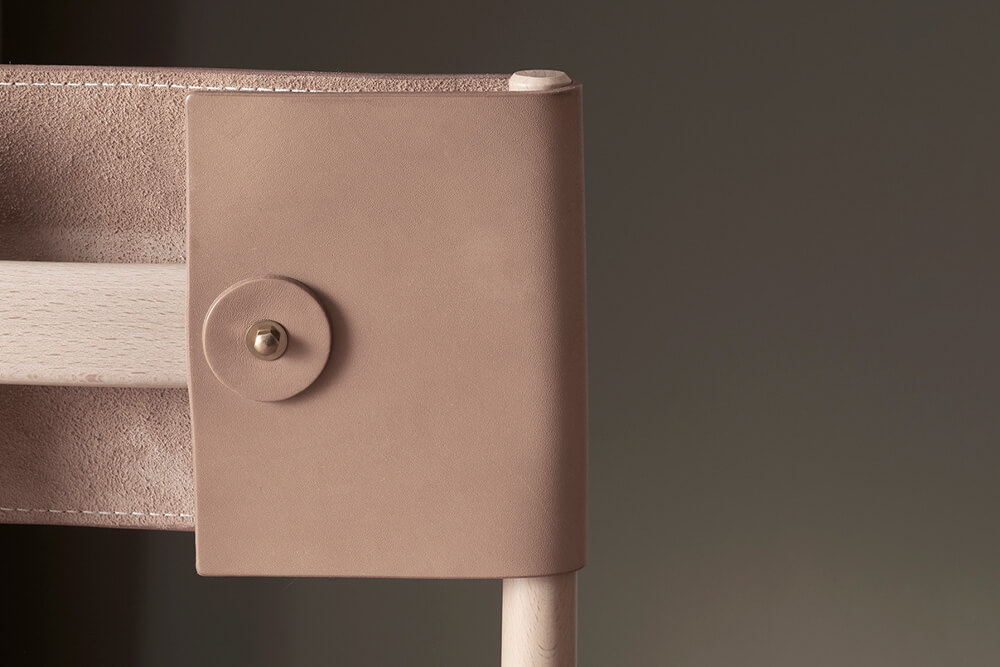
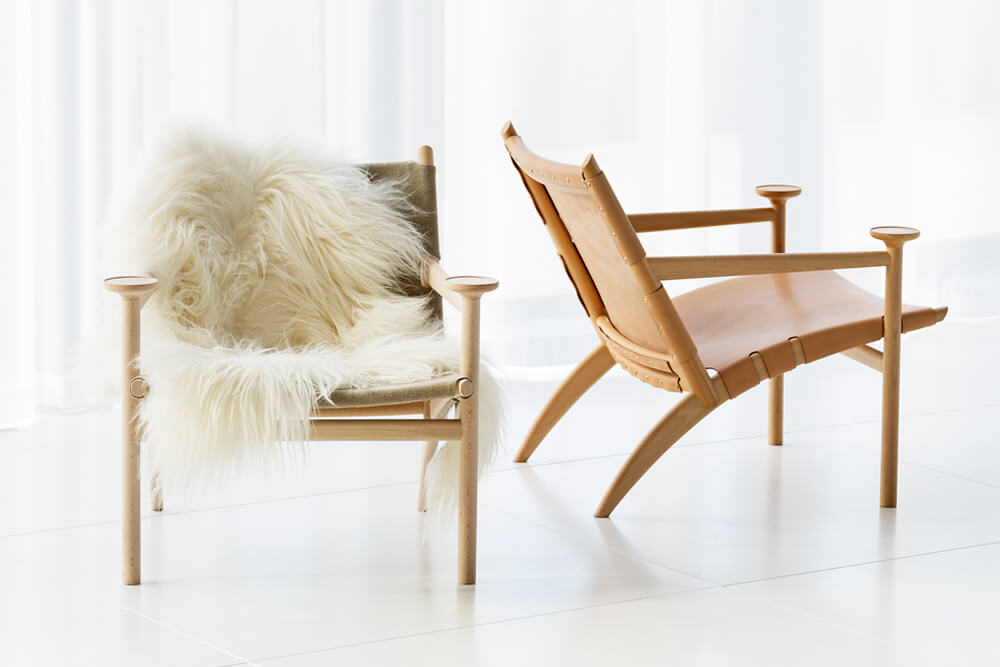
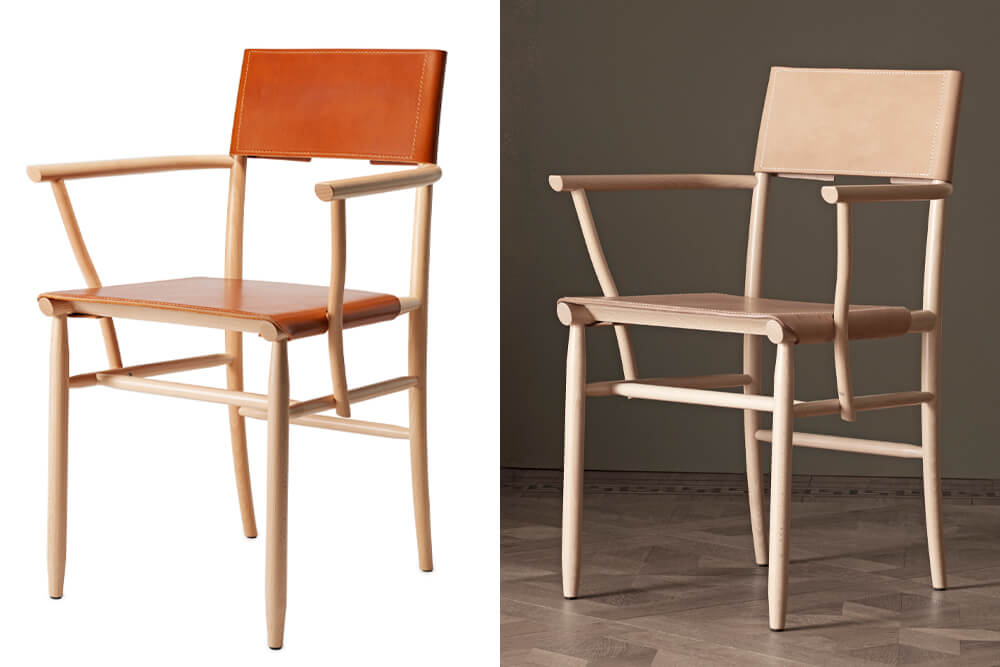
We love leather for many reasons: it’s durable, sustainable, and natural. We try to use mainly responsibly produced leather for upholstery and we mostly make the leather a part of the construction. Like in the Madonna and Hedda chairs, as well as in Hedwig, Ferdinand and Dandy easy chairs.
Leather can be treated and restored for being a long life material. It grows more beautifully and gracefully when it’s well taken care of.
Gärsnäs has a reuse system that is about the renovated, reupholstered, repainted furniture processes for the very same furniture. It is a responsibility for sustainability. It’s the Gärsnäs feeling, as you call it.
What does that mean to you? This feeling.
The Gärsnäs feeling is something immaterial yet worth mentioning; it correlates to our core values when it comes to our designs, which are solidness, thoughtfulness, and awareness. It is also about trust and faith. It represents high moral standards when we as furniture producers interact with a global market trying our best to achieve the environmental goals.
After the Second World War, the company adopted the modern Scandinavian style and started to produce not only furniture for homes, but it also increased its production for the public space. So, could you describe your creation process for, after such a long time as a brand, continuing to create with this unique style?
For us, furniture design is a matter of finding solutions for people interacting and socializing in different situations regardless if it’s about residential or public spaces. We try to add value to existing archetypes, a chair is a chair, but perhaps we can make it lighter and more durable and friendlier to the environment by reducing the amount of material. We can be innovative working with different techniques, and we focus on functionality when we develop furniture for office spaces, hospitality, education/universities, churches, libraries or residential areas.
Form follows function, which means we do not underestimate the value of aesthetics, but we collaborate with a number of skillful designers in order to create pieces of furniture with aesthetic value, which includes: material, techniques, colors, and more. For us, individual expression is highly important and we are constantly working with our heritage sprung from the Scandinavian tradition, which means furniture of high quality, mainly in wood, beautifully constructed and with emphasis on functionality. Materials are mainly wood coming from nearby locations in Scandinavia and Europe, as well as upholstery in fabric and leather.
We would like to talk about the classic Ferdinand. It is an armchair that has everything: comfort, practicality & its leather is vegetable tanned. A modern icon designed by Åke Axelsson. Do you believe that this chair is the design, the piece, the idea that represents the most profound originality of Gärsnäs?
Ferdinand is unique, because we have followed Mr Åke Axelsson since the 1970s, when he studied the ancient chairs and plenty of other historical chairs from ancient times. Ferdinand is inspired by these studies and is fulfilling all aspects of a sustainable chair. Nobody but Åke Axelsson, who has brilliant knowledge and craftsmanship, could make this happen.
What’s your favorite chair in Gärsnäs’ line ever?
My favorite chair ever is always the latest one, perhaps the Petite chair is my favorite.
We look forward to the favorites that are yet to come. Bring it on, Gärsnäs.
Credits: Gärsnäs & Metcha
VOLTA ATELIER
When you speak about VOLTA ATELIER: sustainability, social justice, refugees, social vulnerability, leather scraps, leather handbags, NGO are the incredible mix of words that come to mind.
They work in close collaboration with NGO’s (Non-governmental organizations. NGO’s take up and execute projects to promote welfare of the community they work with. As not-for-profit bodies they do not have any commercial interest). The atelier shows that beautifully made leather bags can have a huge positive social impact, from materials to the chosen team.
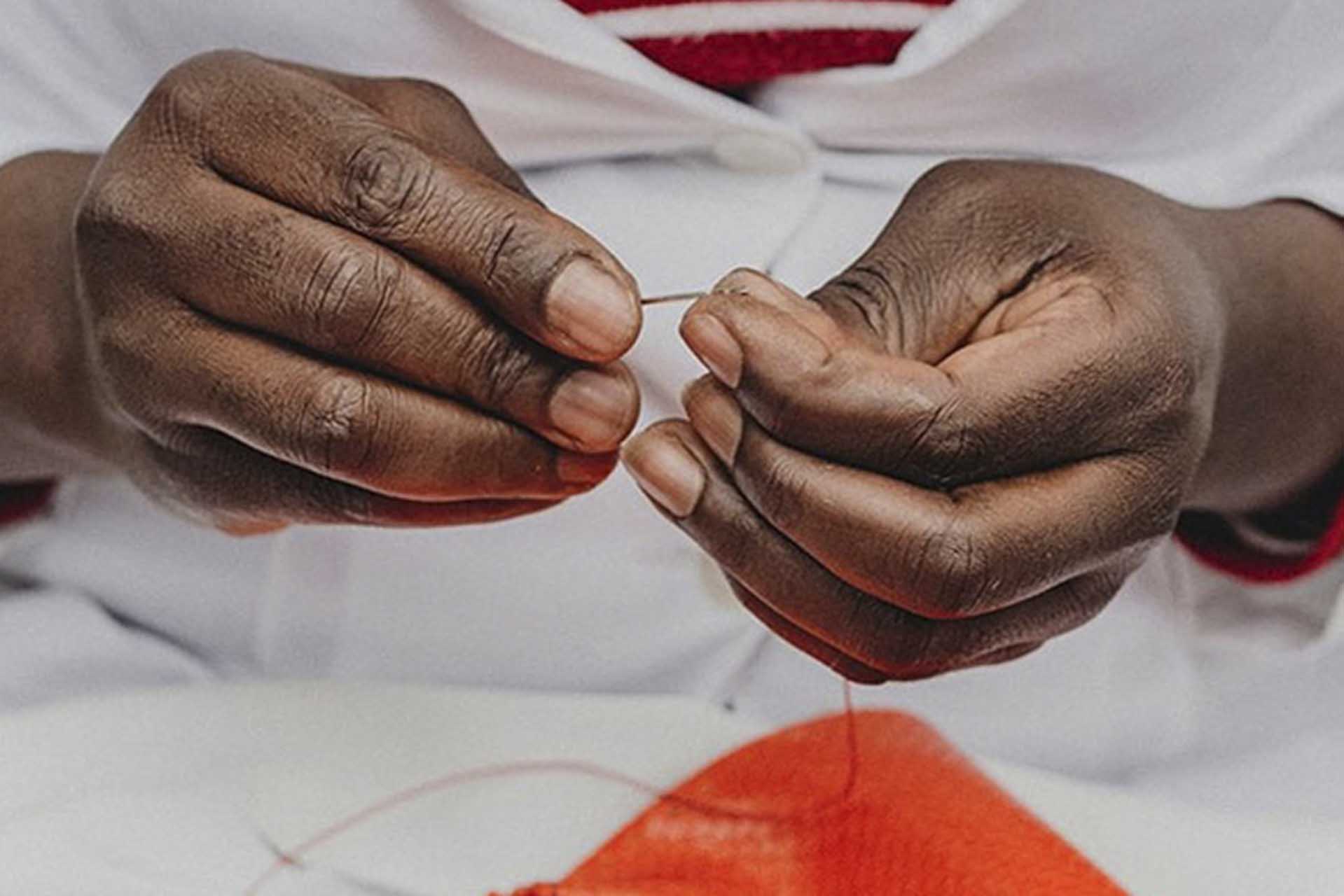
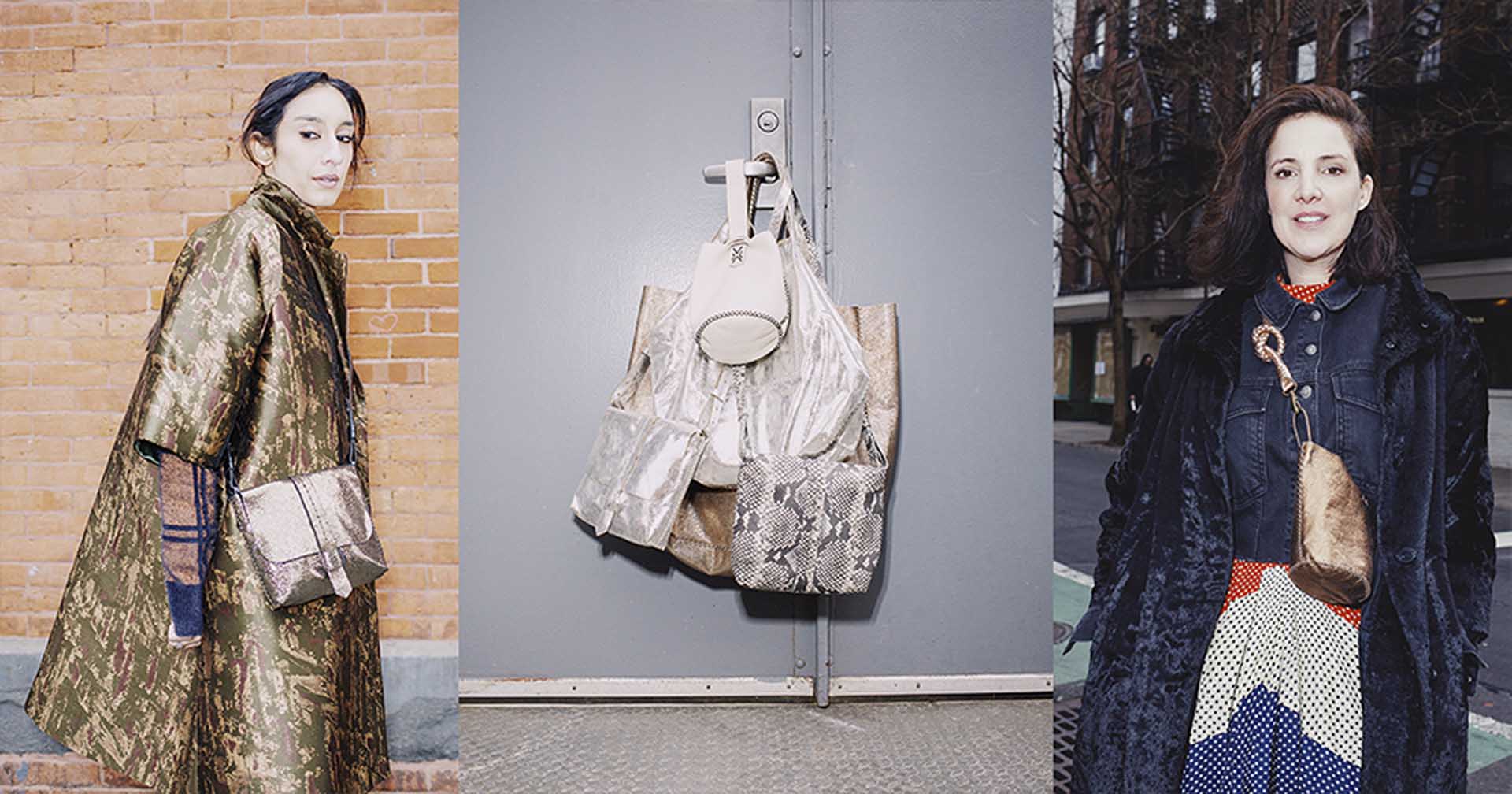
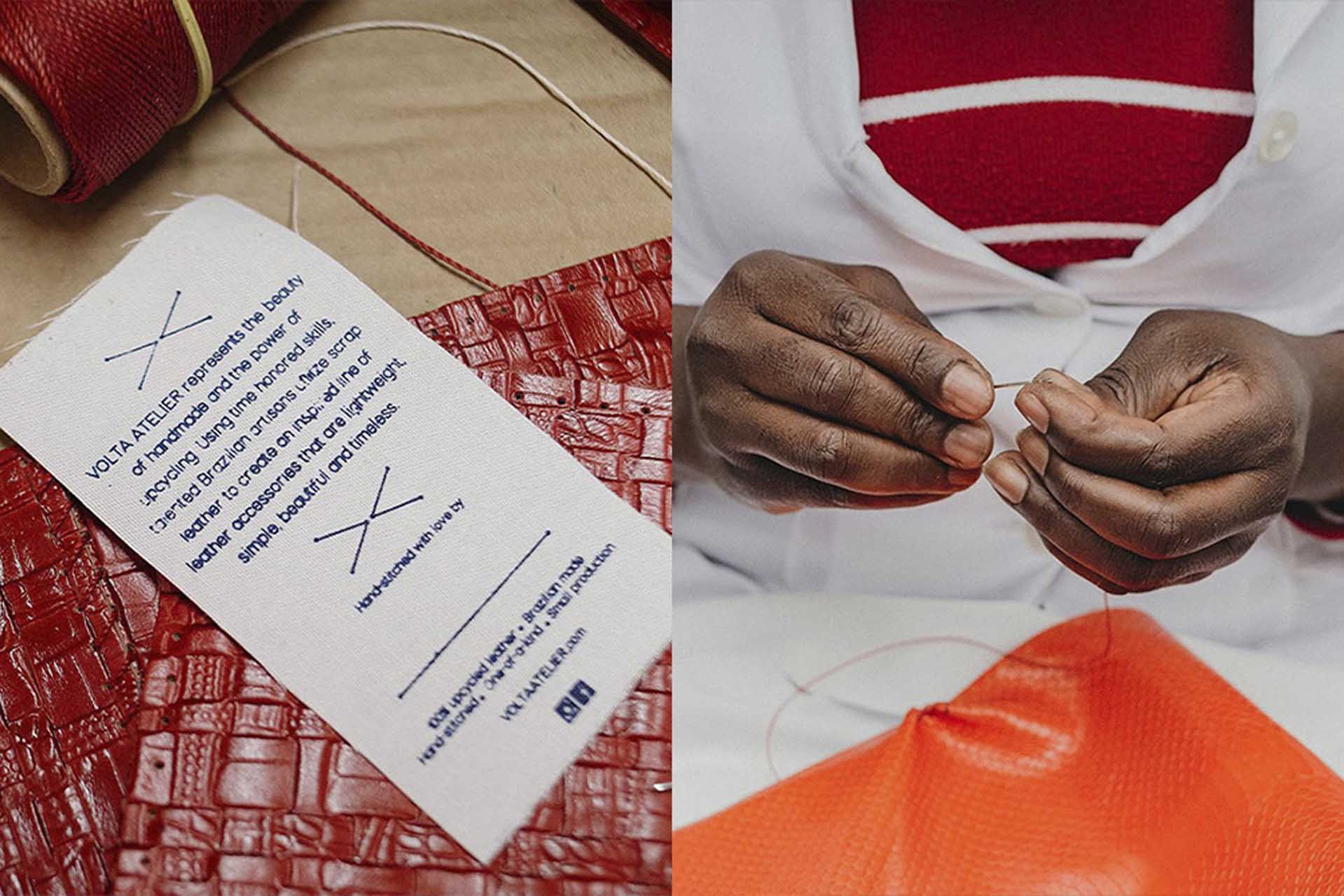
Each creation is hand-stitched by artisan women in social vulnerability, such as refugees from Haiti living in South Brazil, victims of domestic violence or former inmates. The materials used are also one of a kind: transforming 100% scrap leather into designs to covet.
What an amazing brand! Read the interview with Fernanda, founder of Volta Atelier.
How did VOLTA firstly start?
Having worked in the leather accessories industry, I observed the environmental problem caused by the wasted material generated from production, leather among them. At the same time, I was already developing in Brasil projects for the use of artisanal work in accessories within a higher production scale. Working as a trend forecaster I had the understanding that there was room for purpose-driven brands. So, the decision of making accessories using 100% of upcycled leather and artisanal production was a natural consequence of my previous activities.
Do you guys believe that “Waste Is an Error of Design”. What does that mean to you?
The landfill problems we’re experiencing now are in great part a result of a culture of planned obsolescence, which was a design solution at its time. Once Design is concerned with all aspects of a product, waste management should be one of them, not only for the patternmaking creation or for the waste generated during production but also its after-use. The design should not omit this responsibility.
How important is your team during the entire process?
As a brand that produces artisanal products, we rely 100% on our team. Their importance is not only on the work they do. The artisans bring their journey to the brand. These Haitian women, for instance, are an inspiration for us. During their training, we learned about unimaginable difficulties they went through, forced by their circumstances to move to a foreign country, to communicate in a new language. We want our consumers to become part of this, and to be inspired by the story behind each item. That is why each product comes with a tag signed by the artisan who had hand-stitched it.
What is the connection u see between sustainability & working with socially vulnerable woman?
Sustainability and social justice walk side by side. From the seventeen United Nations’ Sustainable Development Goals, at least eight can be considered social goals, as the elimination of poverty, gender equality, social work, and so on. So, for us, sustainability is inextricable from social justice.
How does the reuse of leather happen?
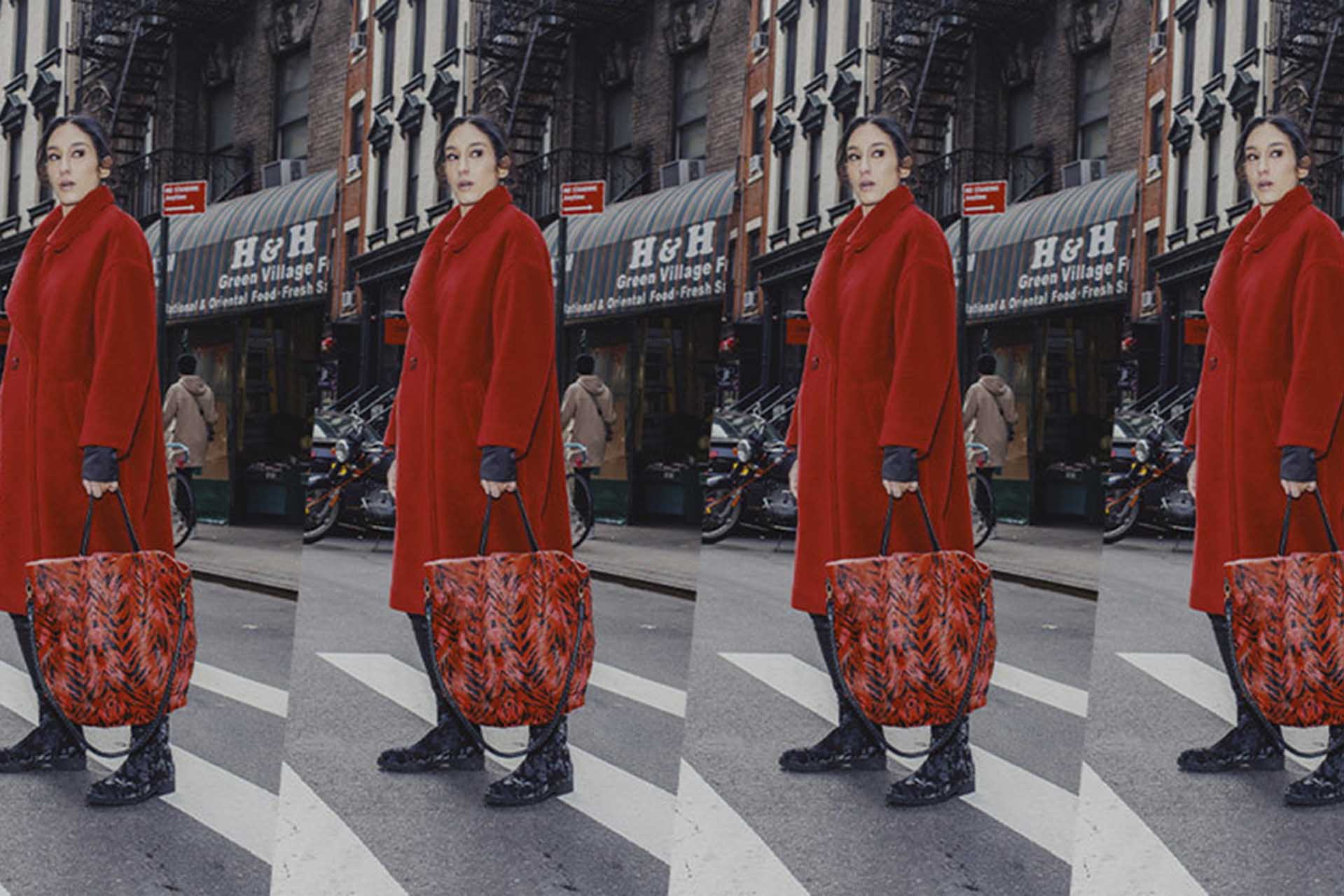
One of the best parts of reusing leather is exclusivity: almost all our bags are one-of-a-kind. This also comes with some constraints. As we are not ordering the production of the raw material, there’s an inverted logic to plan our production. Our company cannot simply decide what to produce. In the beginning, our available material is used to decide what products can be made. I would dare to say it’s a completely new way of thinking production.
And how do you choose the perfect material?
We carefully select our leather scraps from tanneries and factories, after production or a collection. Having worked for this industry enables me to look at different sources to find what fits best for us. In our process, it is crucial to have a good assortment of colors, prints and embossing patterns. Brazilian leather is one of the best in the world but also using it makes sense for us from a logistical standpoint.
What is the big difference between hand-made goods from other types of production?
We believe the big difference is in the connection. There is a connection between the artisans and the items being made. The artisans are incorporating their time, work, attention to detail, and their heritage into the product. When this connection is perceived by the consumer, the product becomes meaningful.
New year, bigger goals — What are the ultimate goals for Volta Atelier?
Apart from business expansion while making a meaningful impact, we want to increase our product mix with items combining other upcycled materials and artisanal techniques. We also want to build collaborations and partnerships with like-minded brands, artists and NGOs.
This interview was first published on Metcha.com

Duke + Dexter Leather Sneakers - Built For The Stroll
Besides the handmade shoes Duke & Dexter has a customisation service 10F1. Make your shoes personal.
Leather is the material of choice in the new Duke + Dexter trainer, which combines rich suede or washable white Italian leather uppers and linings to create the ultimate sneaker for cool city living.
It features a custom sole unit with a specially padded heel section that has a seamless construction for extra comfort.
Handmade in England, each component is sustainably sourced and ordered to use so there is zero waste and nothing left over.
Where is this name 10F1 coming from?
The name 1OF1 was chosen as each custom pair we create is one of a kind, so they are 1/1. We work with clients on a one to one basis to ensure that we create a pair that is personal to them and cannot be found anywhere else in the world.
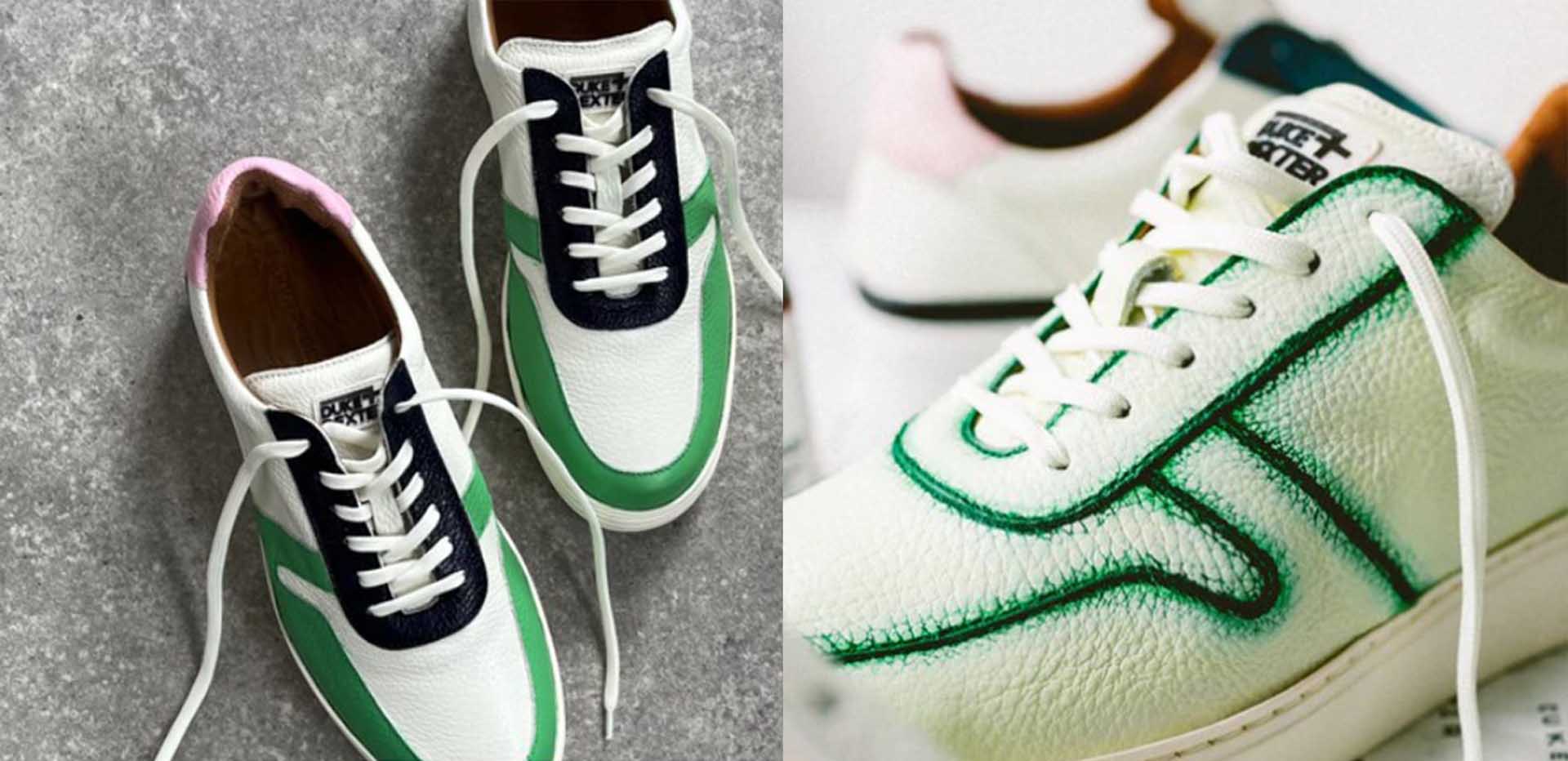
How does this customisation process works?
When a client gets in touch with us wishing to create a custom pair, they are put in direct contact with myself, the artist. I will then talk to them over zoom or email to find out their ideas and wishes for their custom pair, talking them through all our options. Once a design idea has been established, I work on creating design mock-ups to send over to them, getting the clients thoughts and opinions throughout the entire process to ensure it is exactly as they would like.
When the client is completely happy with the design mock-up, I can then begin creating their unique pair. The hand-painting process will take a few hours to complete per pair, allowing them to be created to the highest standard. Once complete, I will seal the painting with varnish to ensure the design is durable and made to last. The custom pair is then carefully boxed up and shipped.
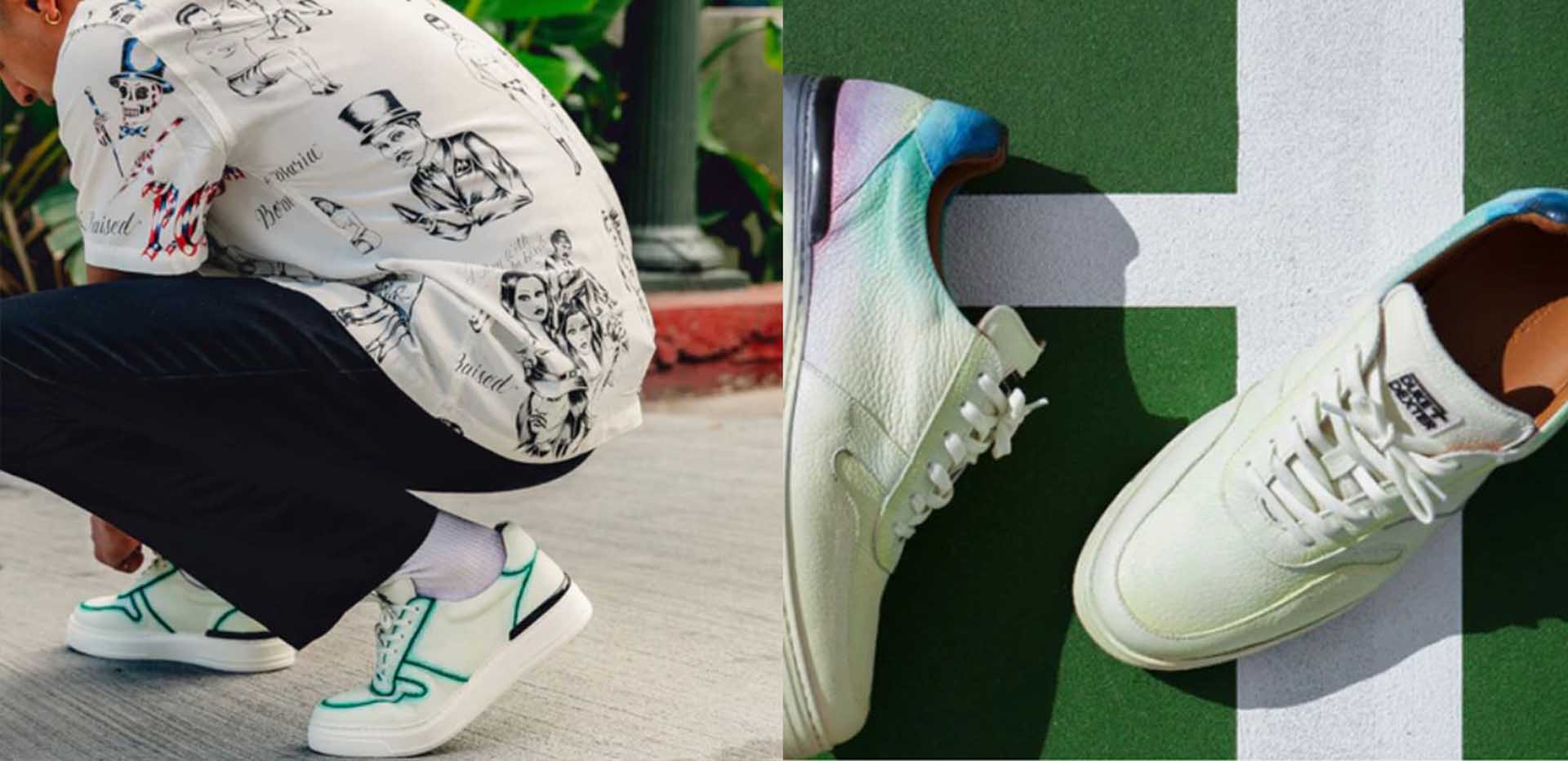
Can you say something about the leather that you use for this new line?
To ensure our hand-painted designs in this line are durable, it is important for us to properly prepare the leather before the design is carefully created on top. This process involves deglazing the leather and then using different grade of sand paper to ensure the surface smooth and therefore the perfect canvas for the paint. This part of the design process takes time and is very important to complete on every custom pair.

In Practice - Leather as a Part of a Circular Economy
How a local partnership transformed waste into beautiful and long-lasting product.
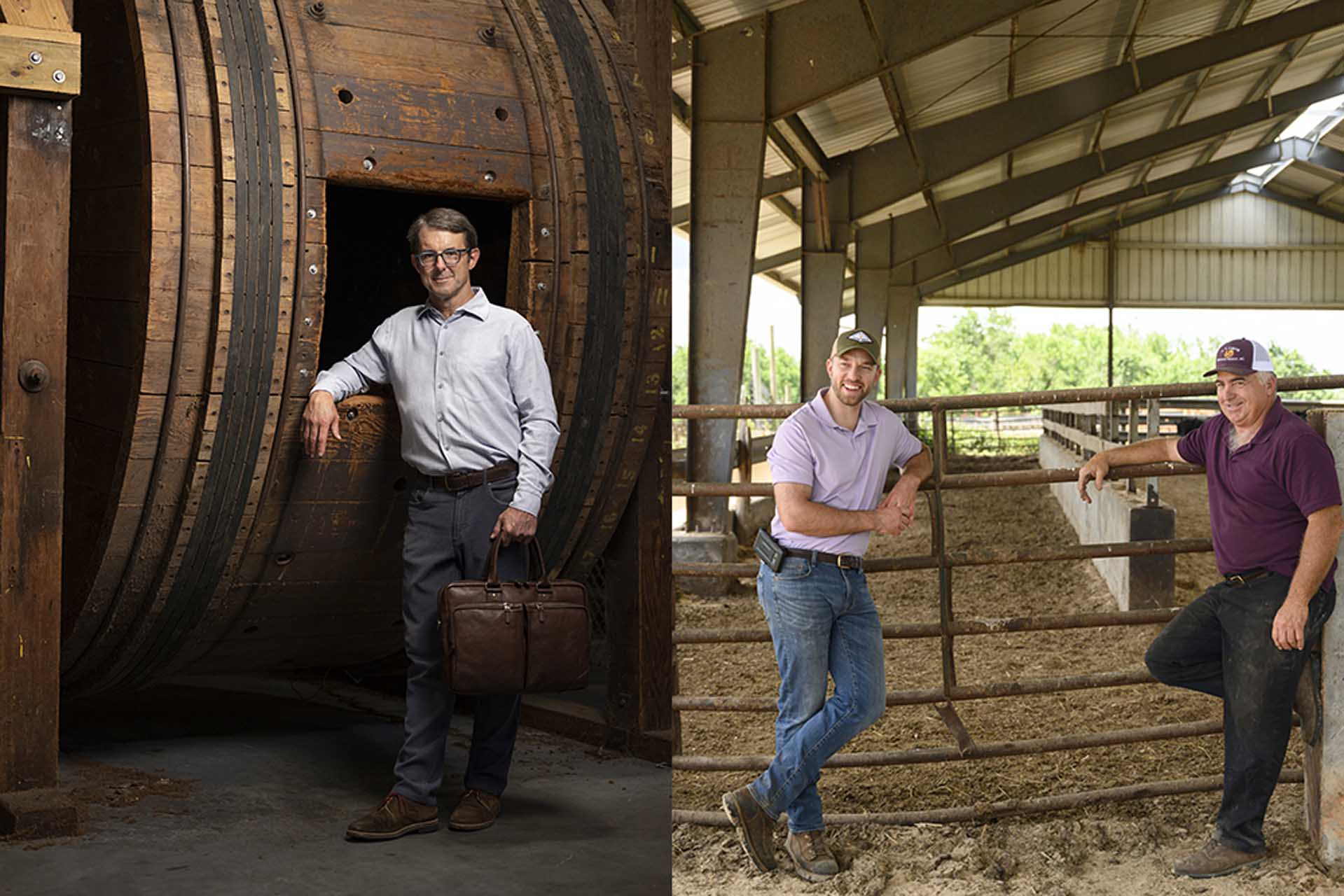
The story begins in Lynchburg, Virginia, known as the City of Seven Hills. Every hide in this collection was sourced from small farms that, like Moore & Giles, have called Virginia home for decades. Moore & Giles partnered with Seven Hills abattoir, a local processor who provides premium beef to restaurants throughout Virginia, to reimagine their by product as an unrealized asset.
Originally destined for a landfill, the hides were instead transported to St. Louis, where they were transformed into leather by Hermann Oak Leather in the same vats and vegetable tannage used to tan the harnesses supplied to westward-moving wagon trains starting in 1881. The quality and allure of the collection is matched by the sustainability and singularity of this locally sourced leather.
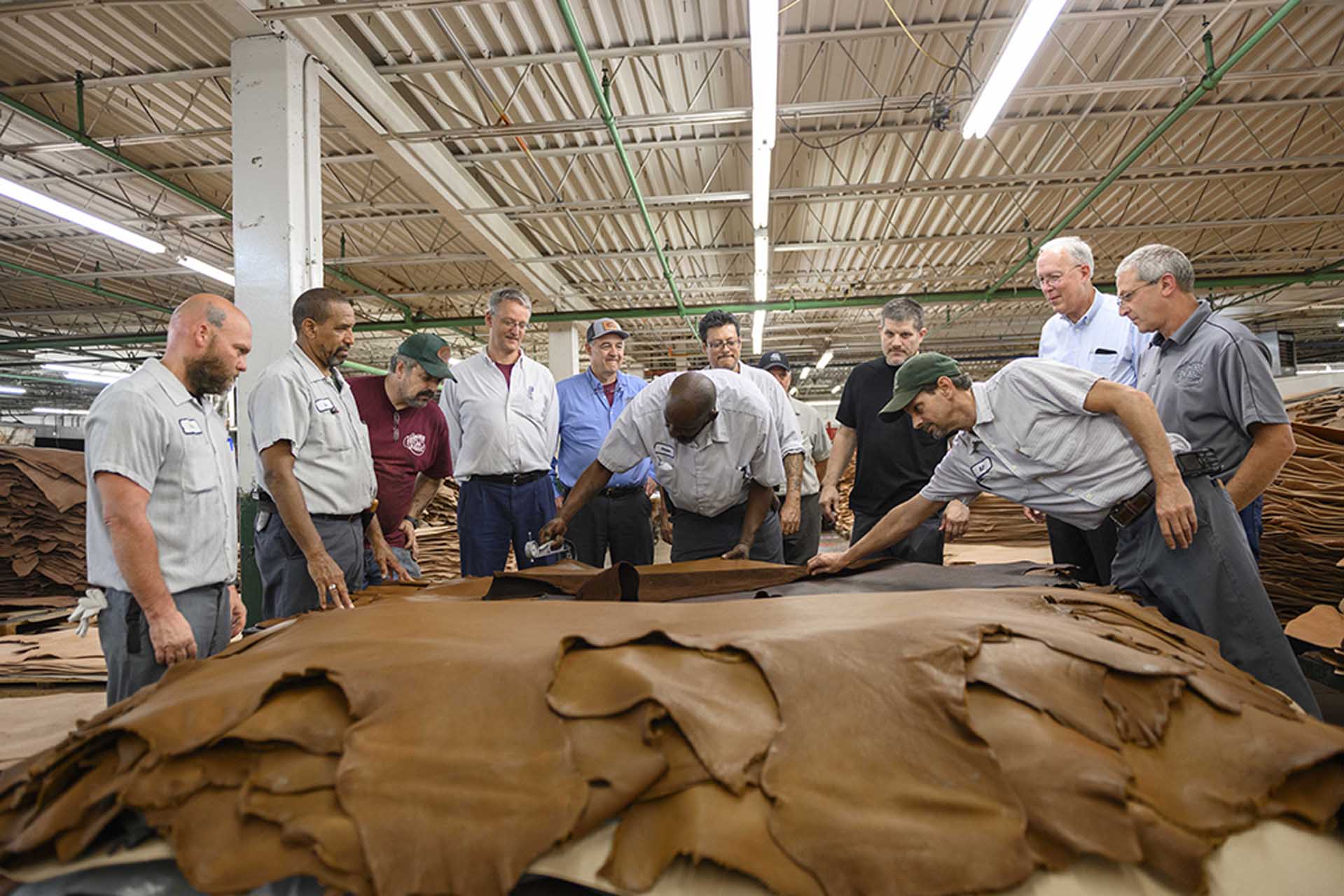
To watch the above story click the link to watch the video
https://vimeo.com/600907012
“The leather industry demonstrates how it contributes to a circular society, where nothing is wasted, everything can be re-used and ultimately can be recycled.”
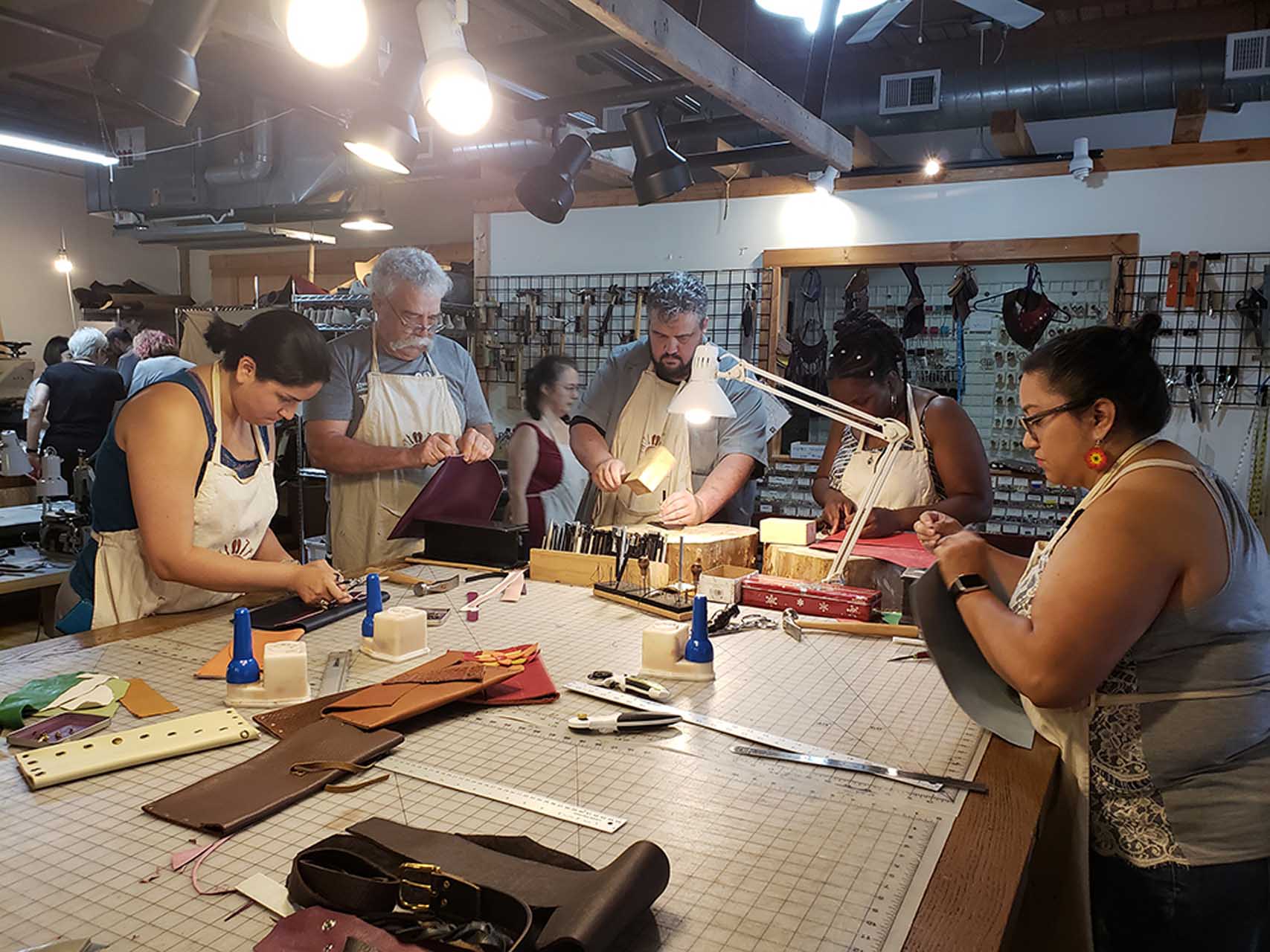
The Chicago Leather School
“I have made over 10,000 pairs of shoes for customers since 1974.”
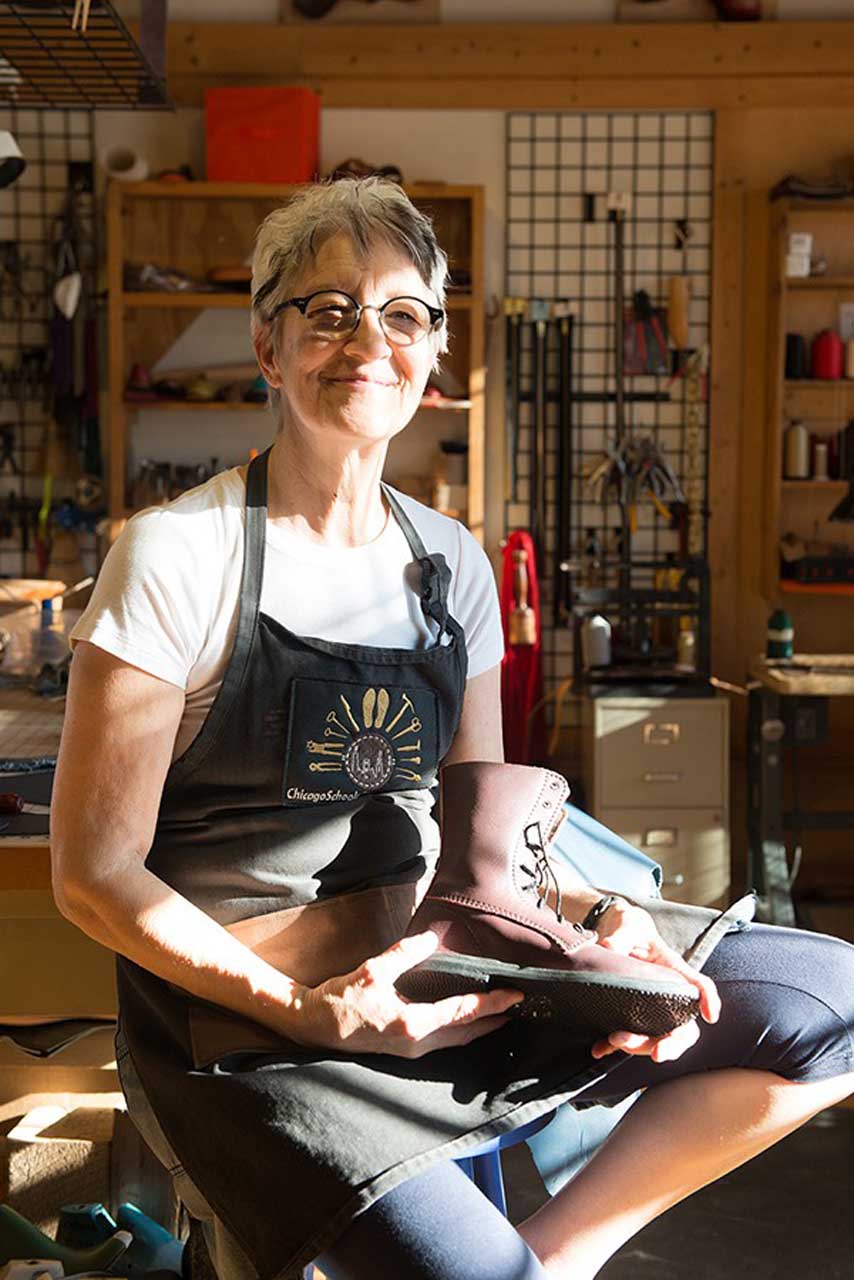
The Chicago School of Shoemaking opened in September of 2011. The inspiration for opening the school came from my 45 years as a custom shoemaker. I have made over 10,000 pairs of shoes for customers since 1974. I saw a niche I could fill by making custom fit handmade shoes and was able to deliver those products for a reasonable price to my customers over the years.
Many trained shoemakers immigrated to the US in times before mass production, expecting to continue their craft in America. Unfortunately, our culture veered away from valuing “slow-made goods” (making a pair of well-made shoes by hand takes approx. 40-50 hrs and more than 120 steps). This quickly diminished the ability to charge what the time and materials were worth and consequently the demand for hand-built footwear. This forced these artisans to shift their focus to repairing shoes and thus, shoe repair shops did a decent business. Currently, most of the shoemakers in the USA are doing business supplying costume footwear for theater and screen as well as for the top 1%. The School feels that there’s an opportunity to create footwear for yourself, family and friends and enjoy the satisfaction and empowerment that provides. One of our more simply made shoemaking styles can be created in 10-12 hours (with some experience) with a material cost of $75-80. They can also be repaired and resoled many times which adds to their sustainability.
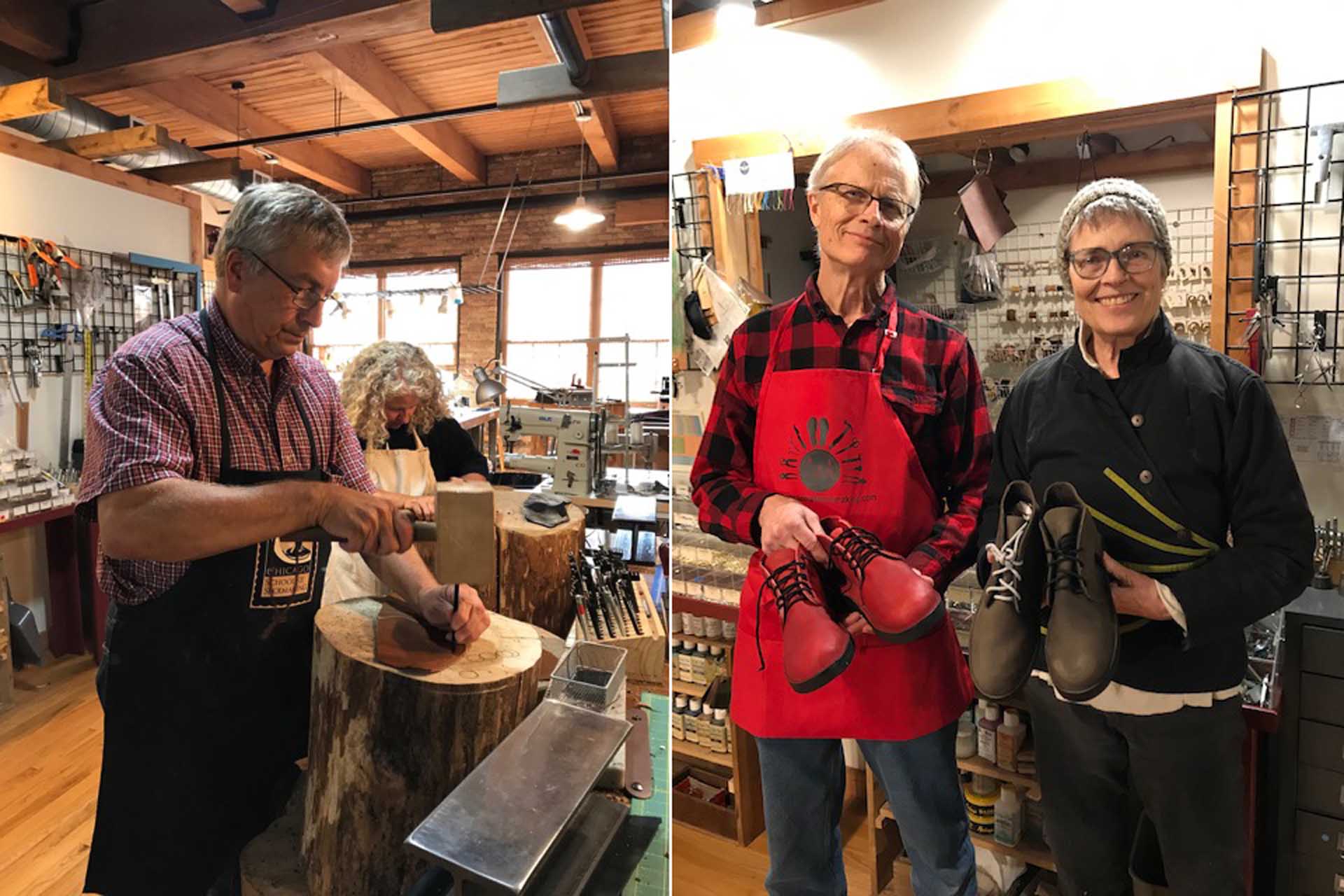
The School is a thriving community of artisans with a penchant for making goods out of leather. In the beginning, our focus was helping students navigate footwear construction, then we quickly branched out to include classes in bag making, wallets, belts, collars, harnesses, cases and more. We wanted to provide an opportunity for people who may never have made anything out of raw materials before to experience what leather work could be for them. We believe that making things with our hands in this technological age helps people connect with themselves in a tangible satisfying way while creating lasting usable products.
We also get excited about introducing footwear construction to our “bucket list” students. So many of our attendees have said that making shoes someday was one of their dreams. Now they can achieve those dreams with us. We have also helped students understand what’s involved in making a career of shoemaking and leather working and are delighted that we can get them started down a rarely taken path.
The qualities of leather are uniquely suited to creating footwear. Certain types of leathers provide us with a material that can be molded and stretched, easily cut with sharp tools, and also add protection from the elements. The variety of leathers available in this current age is extraordinary—from bull-hide to fish leathers for example! Once one learns the general qualities of the tanning processes and what that produces, they can choose the right tannage, the correct weight and the proper finish for any leather working project. We hold 4 day Intensives on a regular basis that help students understand how to select the proper leather for each project and get them started on construction techniques.
In the future, we hope to reach out to schools and colleges to demonstrate what a course in leather working and shoe construction can offer their student populations and add to their toolkit. We’re poised to create a designated course for fashion and furniture designers and builders. The Chicago School of Shoemaking and Leather Arts is a “one of a kind” artisan space.
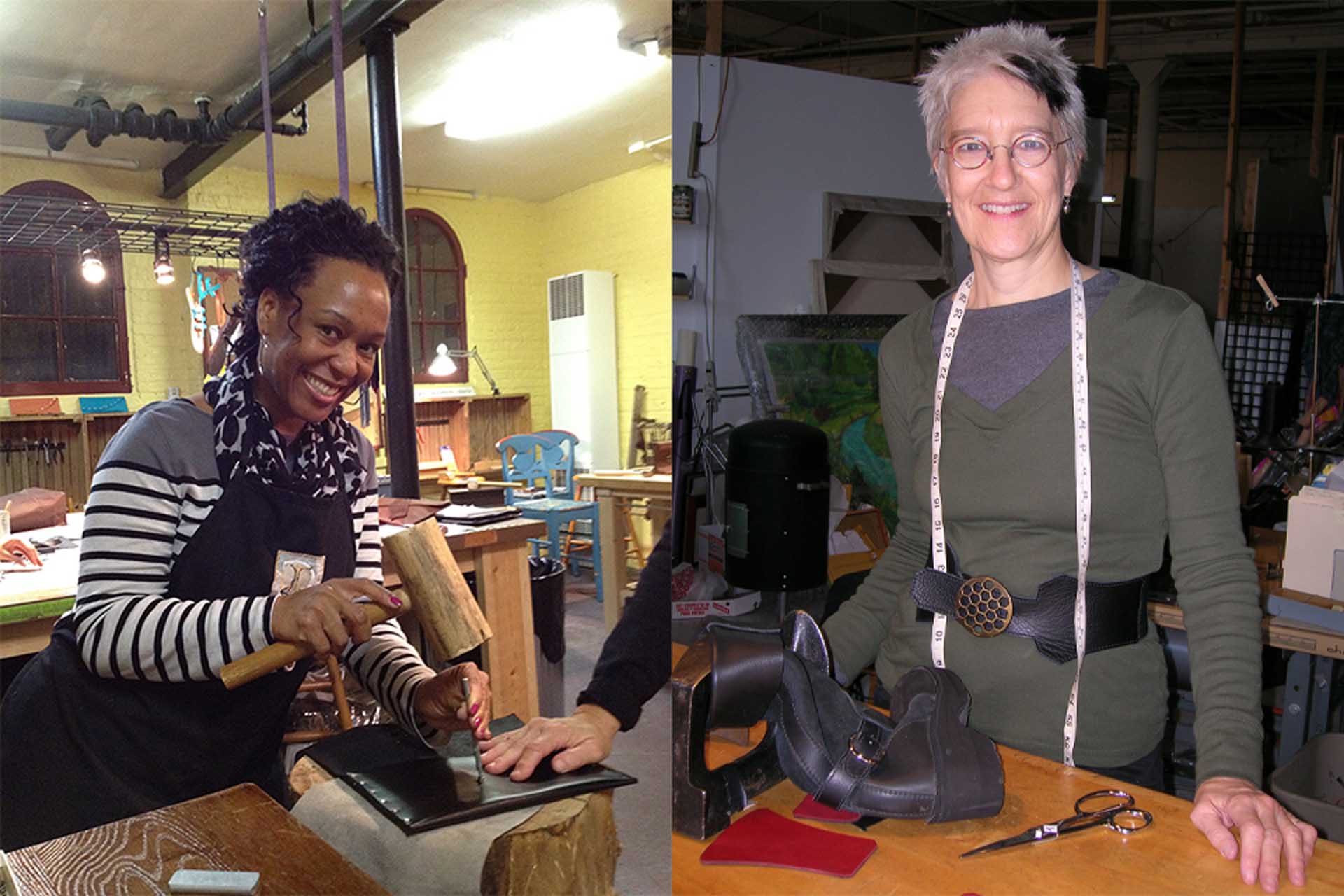
Sara McIntosh
Founder, CEO
Chicago School of Shoemaking & Leather Arts
Slow Fashion Challenge for International Design Competition
The Real Leather. Stay Different search for new design talent is now on.
Open to anyone studying art and design or who has graduated from art and design higher education within the last two years, the Real Leather. Stay Different. International Student Design Competition 2022 (RLSD ‘22) is run in partnership with ArtsThread. Its mission is to encourage a new generation of designers to reconsider their relationship with leather and other natural materials to create stunning designs where longevity and minimal environmental impact is key.
CLOSING DATE: 30TH JUNE 2022
The competitor has also announce the appointment of two industry-leading figures to the judging panel. Christopher Koerber, Managing Director of HUGO BOSS Ticino and Rosie Wollacott Phillips, Group Sustainability Manager of Mulberry, join celebrity fashion stylist, Mike Adler and the 2021 winner, and FIT NYC graduate, Emily Omesi for the final, in London on 15 September 2022.

Christopher Koerber, comments:
“For HUGO BOSS, sustainability means creating innovative, high-quality products while taking responsibility for ensuring ethical corporate governance. We bear responsibility for a complex global value chain and choose our suppliers and distributors carefully. We are committed to making it more sustainable from start to finish.
A significant contributor to achieving a sustainable future for fashion is advocacy amongst our peers and future influencers. Raising awareness amongst young designers about the role they can play by simply choosing more sustainable and appropriately sourced materials is vital. This is why I am pleased to support RLSD ‘22 as it will help to drive positive change and innovation by inspiring the next generation of design talent.”
Rosie Wollacott Phillips, Group Sustainability Manager at Mulberry, which since producing its first 100% sustainable leather handbag in 2019 has now committed to becoming net-zero by 2035 and to developing the world’s lowest carbon leather, added:
“I am delighted to be part of the judging panel for this year’s Real Leather. Stay Different. International Student Design Competition. It is an important opportunity for us to talk to tomorrow’s influencers and to encourage designers to really consider working with natural, sustainable, and responsibly sourced leather.
The leather industry diverts two million tonnes of global waste from landfill every year and converts unwanted materials into accessories, clothing and footwear which are made to last. Leather is a beautiful, sustainable material when sourced properly, and the proponents of slow fashion have a responsibility to champion it.”
Chairman of the judging panel Steven Sothmann pointed out the waste that the fashion industry creates, not just with disposable fast fashion but in its material choice:
“Forty per cent of hides from the meat and dairy industry are thrown away, ending up in landfill. So, when considering a leather purchase, you can do so in the knowledge you’re helping to reduce waste and lowering the CO2 emissions of landfill.”
Competition entrants will be challenged to design a single piece of clothing, footwear or accessory using 50% or more leather. Shortlisted finalists will be invited to present their design concept to the judges during a live showcase final, with an all-expenses-paid trip to London, during Fashion Week in September.
As part of the prize for making the global final, finalists will have their design professionally made to present to the judges.
The competition is now live, with entries being accepted until 30th June, more details here.
Announcing World Leather Day, March 30th 2022
I am text block. Click edit button to change this text. Lorem ipsum dolor sit amet, consectetur adipiscing elit. Ut elit tellus, luctus nec ullamcorper mattis, pulvinar
Leather Working Group (LWG) and Leather Naturally (LN) are introducing this global initiative to encourage organizations within the leather industry to positively promote leather.
As their first collaborative initiative, World Leather Day 2022 will be introduced on March 30 by Leather Working Group (LWG) and Leather Naturally (LN), with the aim of getting everyone talking about leather, raising awareness about the positive attributes of leather, and encouraging the industry to participate in next year’s event. World Leather Day 2022 conveys the core message that Leather is a durable, versatile, upcycled material.
“Leather Working Group is centered around positive collaboration, and we are proud to be one of the initiating partners of World Leather Day. It is an exciting communications event that aims to raise awareness and give the industry a well-deserved moment of positive press.” – Christina Trautmann, Head of Leather Working Group.
Over the years, the leather industry has suffered from a lack of communication and as a result, this has impacted the understanding of people outside of the industry. But a future with greater connectivity, transparency, and communication provides our industry with the opportunity to convey our own image. This is one of the key drivers for World Leather Day.
“Leather Naturally is pleased to be involved in organizing the World Leather Day to inspire brands, designers, and consumers about the sustainability of leather and the important role it plays in a circular society where nothing is wasted, everything can be reused, and ultimately is biodegradable.” – Egbert Dikkers, Chair of the Leather Naturally Management Board.
Take part in World Leather Day 2022
To get people talking about leather, a visually engaging social media toolkit has been created to convey the four core messages of World Leather Day 2022. Whether your organization is a leather manufacturer, brand, retailer, or supplier to the industry, you can request the social media toolkit and share it on your social media. The toolkit has also been constructed with different languages in mind, so you can translate specific elements into the language of your choice.
You can request the social media toolkit today by contacting
sonja@leathernaturally.org.
Get involved in World Leather Day 2023
As World Leather Day 2022 is only just around the corner, both LWG and LN recognize that many organizations across the sector would want to get involved in 2023. The plan is to have a much wider-reaching campaign that would involve multiple partners and signatories. To get involved in next year’s World Leather Day, contact Debbie Burton at Leather Naturally, info@leathernaturally.org.
###
About Leather Working Group (LWG)
The global multistakeholder, Leather Working Group (LWG) , is a member-led not-for-profit organization that is dedicated to driving excellence in the leather industry, minimizing the impact of leather production and challenging industry perceptions, through a suite of tools and ESG certification. Discover more at www.leatherworkinggroup.com
About Leather Naturally (LN)
Leather Naturally promotes the use of globally manufactured sustainable leather. Its website www.leathernaturally.org is a key resource for information about modern leather manufacturing and the part it plays in a more sustainable society.
dapibus leo.